essay
My first Ocean(wo)man
It can be both discouraging and comforting to learn how long it takes to get good at something. Frankly, it is entirely contingent upon how you look at it. Glass half full or half empty sort of thing.
In a 1993 study, Anders Ericsson from the University of Colorado observed the difference in practice routines of violinists who started playing around the same age and found that the elite performers had clocked over 10,000 hours of deliberate practice by the age of 20 (which he equated to roughly a minimum of 10 years of sustained training), while others’, well, non-elite violin players’ practice volume averaged 4,000 hours. [link]
While I am not an elite swimmer by any means, it took precisely 10 years for me to conquer the full Oceanman race.
Exchange year in Hawaii
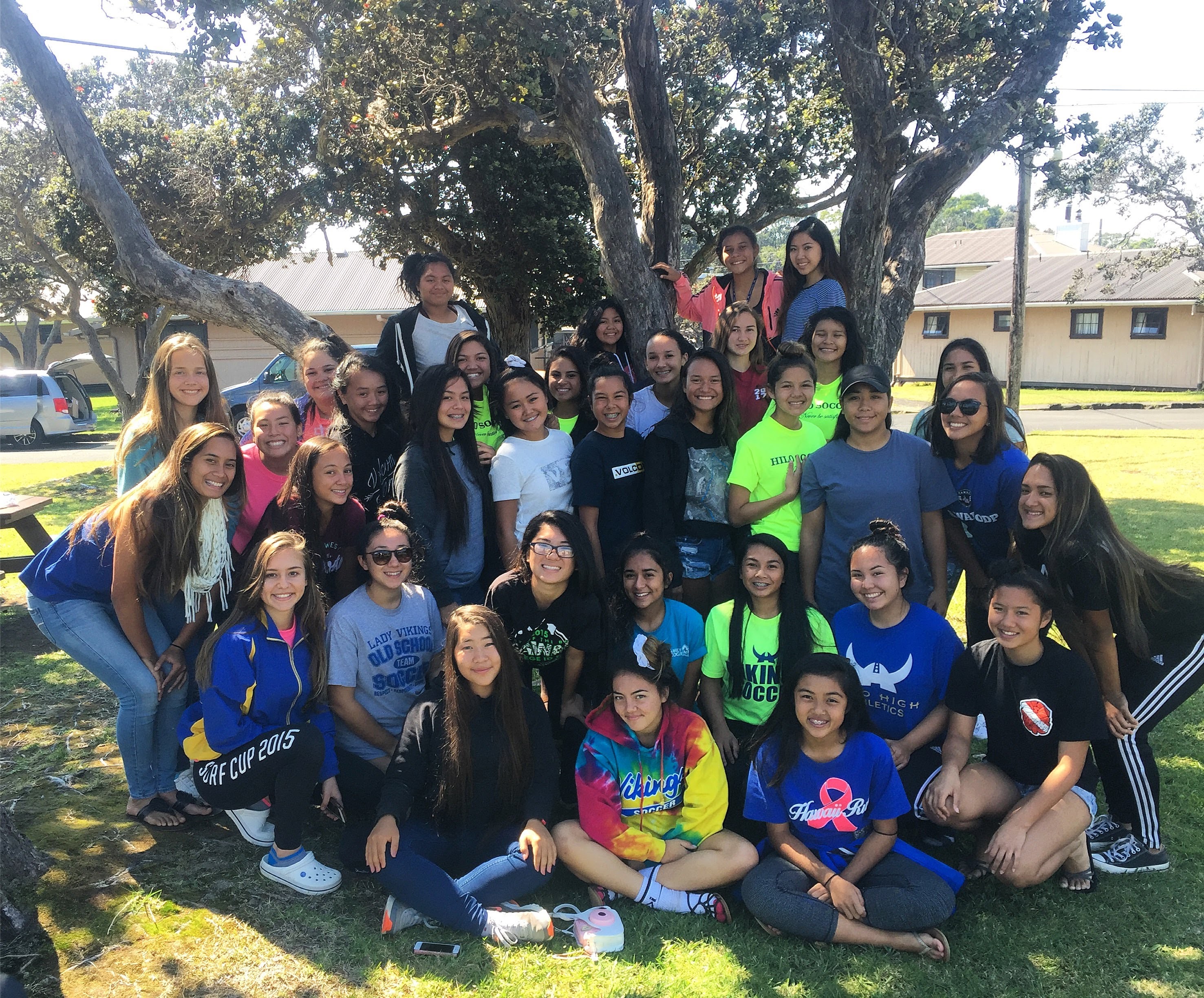
I learned to swim when I was 16 as an exchange student at Hilo High School. I had signed up for a swimming class to count towards my P.E. credit. Imagine local high schoolers, for whom knowing how to swim is akin to knowing how to breathe, encountering someone from a landlocked country in Central Asia who claimed, in broken English, that she needed to be at the shallow end of the pool. After a while and countless gulps of chlorinated water, the class became my favorite part of the day. I learned the basics of freestyle and backstroke pretty quickly, and I spied on my classmates’ breaststroke under water, attempting to dissect their effortless technique. I was truly puzzled by the way they glided so smoothly when I barely moved even if I put all my will and might in that frog kick. It was much later I learned that breaststrokers are born, not made.
Despite my astonishingly average swimming skills, my host mom, my biggest supporter to this day, encouraged me to join the water polo team for the upcoming season. I had already finished a season of cross-country and girls’ soccer, even got to fly to Honolulu for a state championship as a girls' soccer team manager. In truth, the only managerial responsibility bestowed upon me was carrying a pack of filled Gatorade water bottles for girls to drink during practice and games. The real reason I went was that the junior varsity season was over and the varsity girls loved having me around. We had loads of fun. I joked about how American they are and they lovingly teased me for the funny way I pronounced some words.
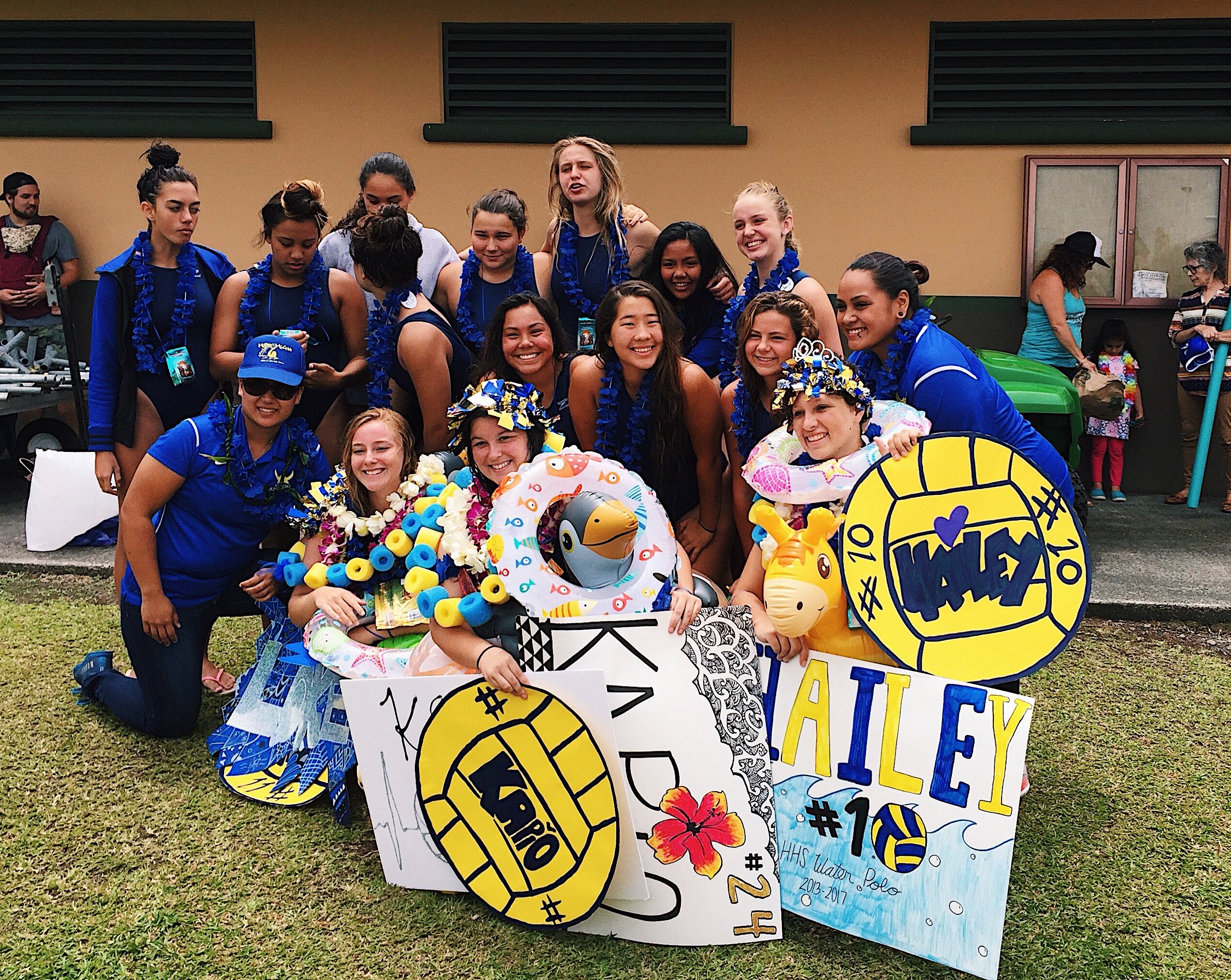
Malia, my water polo coach, was a tough cookie. Apart from practice in the pool three times a week, she scheduled 6am crossfit sessions on Saturdays. She’d do detailed game plan sit-downs, drawing plays on whiteboard and drills for us to try in water. Each drill had a name! Mind you, I had only learned to express my thoughts semi-clearly and my listening comprehension was still subpar. This greatly affected my game in water, since I could barely understand the commands and the water polo jargon coach Malia was shouting out from the stand. Nevertheless, she was very patient with me. Not overly coddling in any sense, but I felt respected because I knew she knew I did my best. She told us to get a notebook where we could journal our thoughts, things we can improve, and things we got a good hang of. She’d collect those end of each week and write a note underneath our entries with words of encouragement and feedback. Looking back, I am quite amazed at how thorough Malia’s coaching was. Even if I warmed the bench for most of the games against other teams, I loved practicing and the team spirit was palpable.
Transition into adulthood
Once my exchange year had come to an end, my swimming career took a lengthy break. Upon returning to my hometown Pavlodar in the northeast of Kazakhstan, I had 12th grade to finish and universities to apply. In Almaty, majoring in foreign languages at KIMEP, I was trying to find a pool nearby but it was quite pricey for a poor scholarship student, who had also taken up a part-time job tutoring English to cover living expenses in the most expensive city in the country. Then, COVID hit and I was back in Pavlodar. To my delight, a shiny athletic center with an Olympic-sized pool opened up. In the morning, I’d take Zoom classes and in the afternoon, I was swimming laps in an empty new pool with a crooked technique. The lifeguard who used to be a competitive swimmer would give me good tips, most probably because he saw how much I struggled. Then, I had to return back to Almaty to finish my degree.
The next and the biggest surge of swimming hours I put in was when I got into Nazarbayev University for graduate school in 2022. The students had access to both the Olympic-sized pool and the gym on campus for only a dollar a month. I am convinced that easy access to sports facilities has a profound impact on youth athletic achievement. The sheer number of Olympic medalists from the United States is a testament to this. Even an underfunded public school in the U.S. has a pool and employs coaches who love what they do. Families love sports and organize fundraisers selling lunch boxes to fund team trips. Perhaps this is one of the major positive cultural shocks I had in Hawaii.
iSwim
At Nazarbayev University pool, I noticed coaches wearing t-shirts with “iSwim” logos. They did not work for the university, the swimming club rented lanes and provided classes for beginners, intermediate swimmers and competitive youth groups. I was curious and signed up for adult group training with Arman. The rest, as they say, is history. As a result of a supportive team environment, Arman’s training plan, and sessions that pushed beyond what we all thought we could do, my technique got much better. I was setting PRs for 50m and 100m sprints every time, and a year later, I finished Half-Oceanman (5k swim race) in Dubai. I came 9th in my age category and qualified for the Half-Oceanman World Championship in 2025. Instead, after another year of consistent training, three times a week at 7am, 3-4km each practice, I decided it was time for a full race.
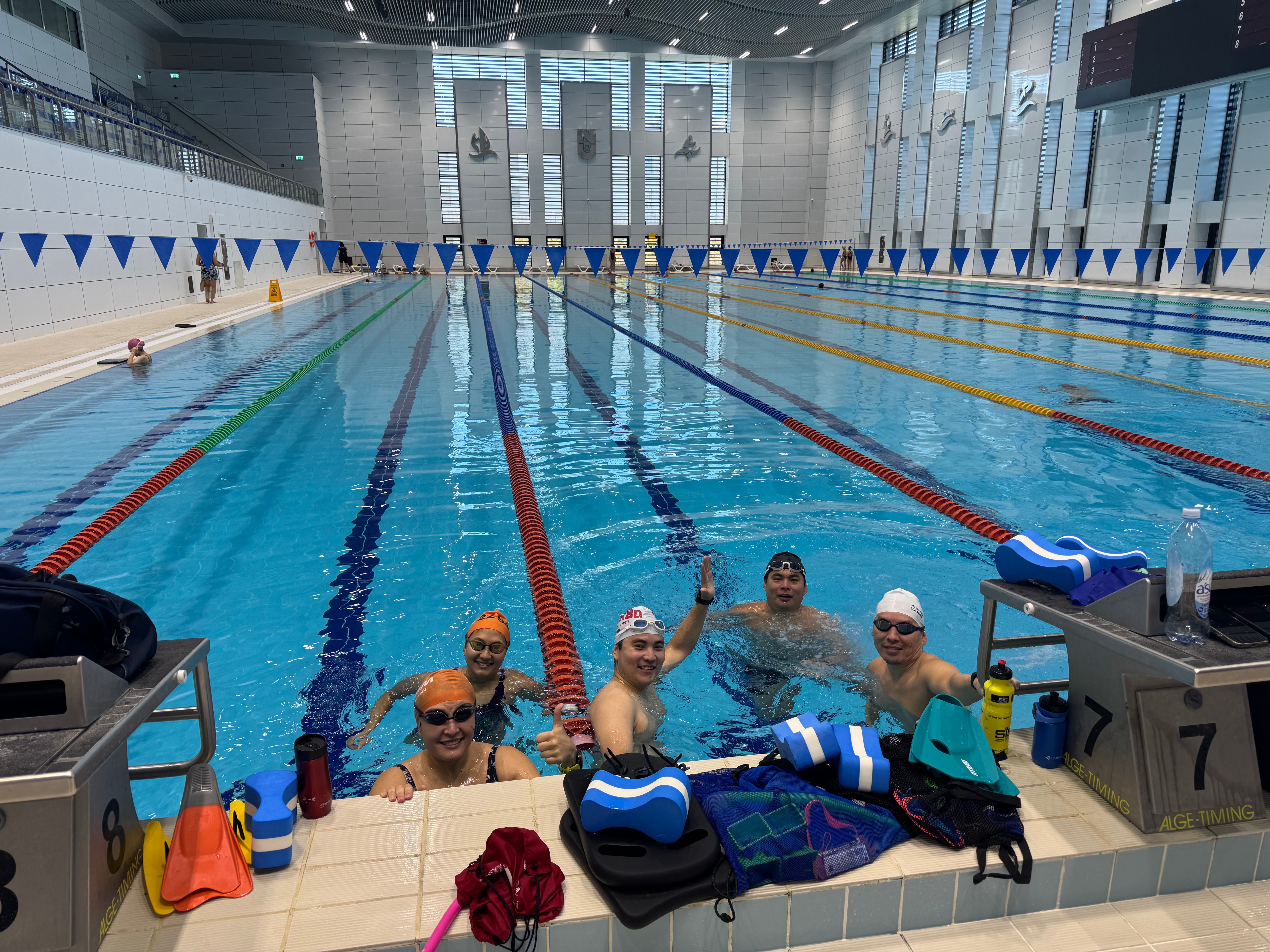
I had only swum 10k in the pool once in 2025 and my time was 4 hours 18 minutes. In 2026, I was going through growing pains, adjusting to the demands of my dream job at university and the rites of passage every self-respecting emerging adult experiences. I expressed my intention to do a full Oceanman to Arman, to which he said, “Well, you have to prove to me you can do it, you’ve skipped many practices for the past couple months.” It was true. The nighttime rumination led me to fall asleep at 5am no matter how early I was in bed, with practice at 7am and work at 10am.
On June 22, two weeks before the official race, I was in the pool at 6am and started my second 10k ever. I finished in 3 hours and 43 minutes, exactly half an hour improvement from my previous 10k in the pool. As per my teammates’ advice who’d already done full races, I had one gel at 4k and one at 8k to push through the end. The cutoff time for Oceanman is 4 hours and 30 minutes. I had Arman’s blessing to do the race.
I arrived in Kapchagay a day early, picked up my swimming cap and a race bib stickers that are incredibly hard to scrape off of your skin afterwards. Went to a briefing, carefully listening to the navigation instructions. For dinner, I had a delicious Fettuccine Alfredo and a Tashkent tea on the shore. I was in bed by 10pm. In the morning, the organizers announced that swimmers are advised to wear a wetsuit due to colder weather conditions. I didn’t bring one. Lucky me. Neither did another swimmer from France, who signed up for a race while on an internship at a French embassy in Astana. I think we were one of the very few swimmers who did not wear a wetsuit. We bonded over this, naturally, and even went out in Astana couple of times before she left back to France.
The race
Ready. Set. GO!
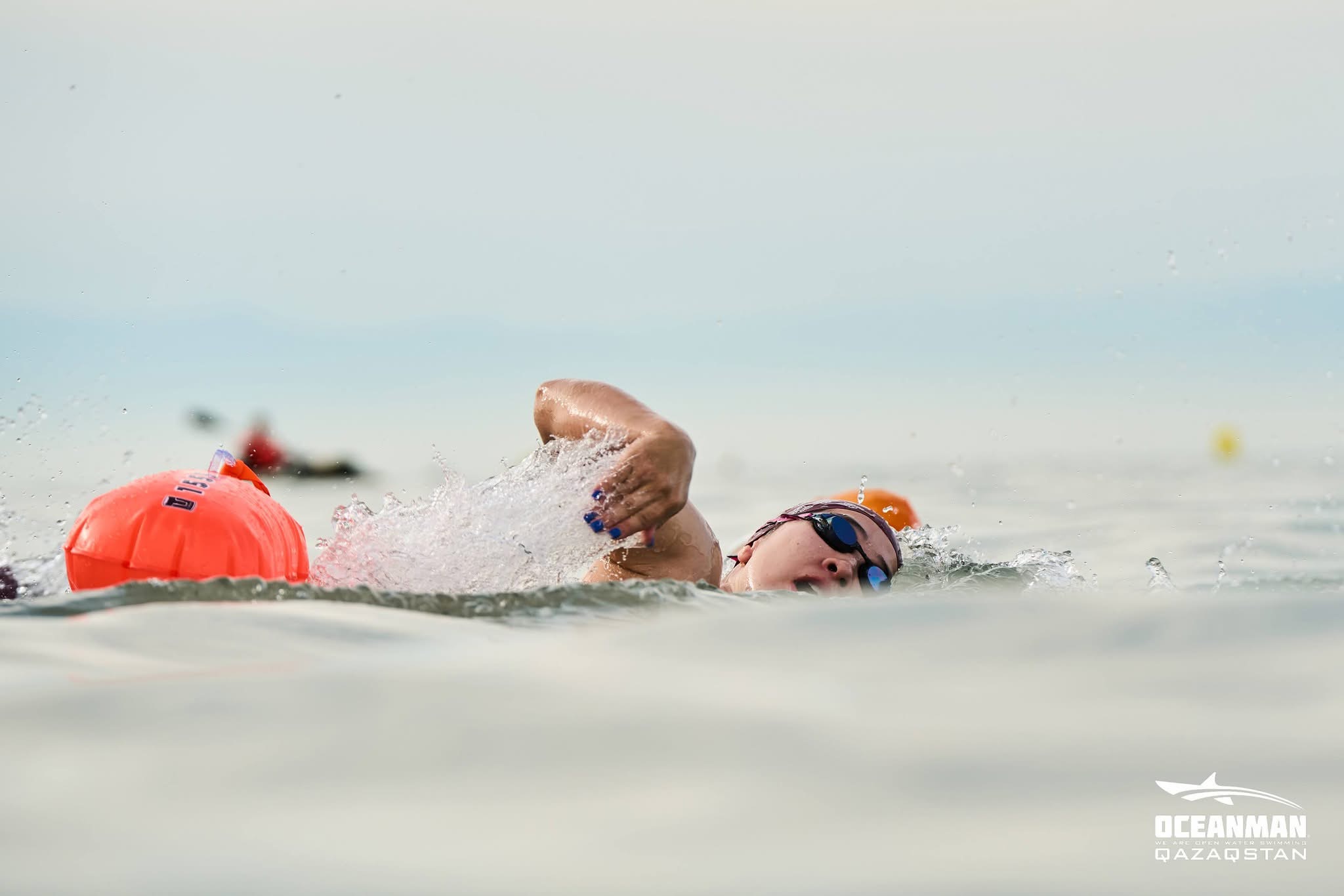
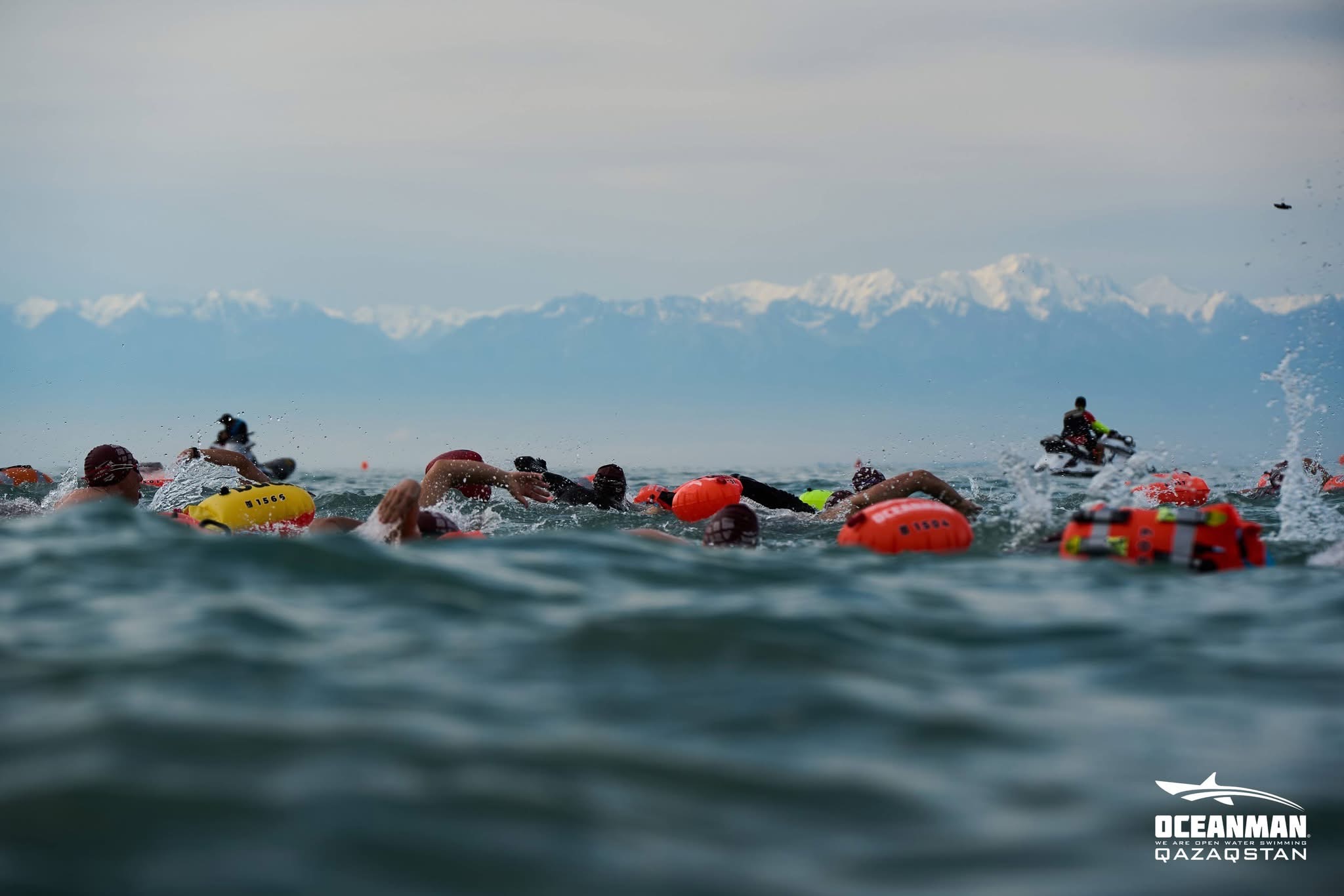
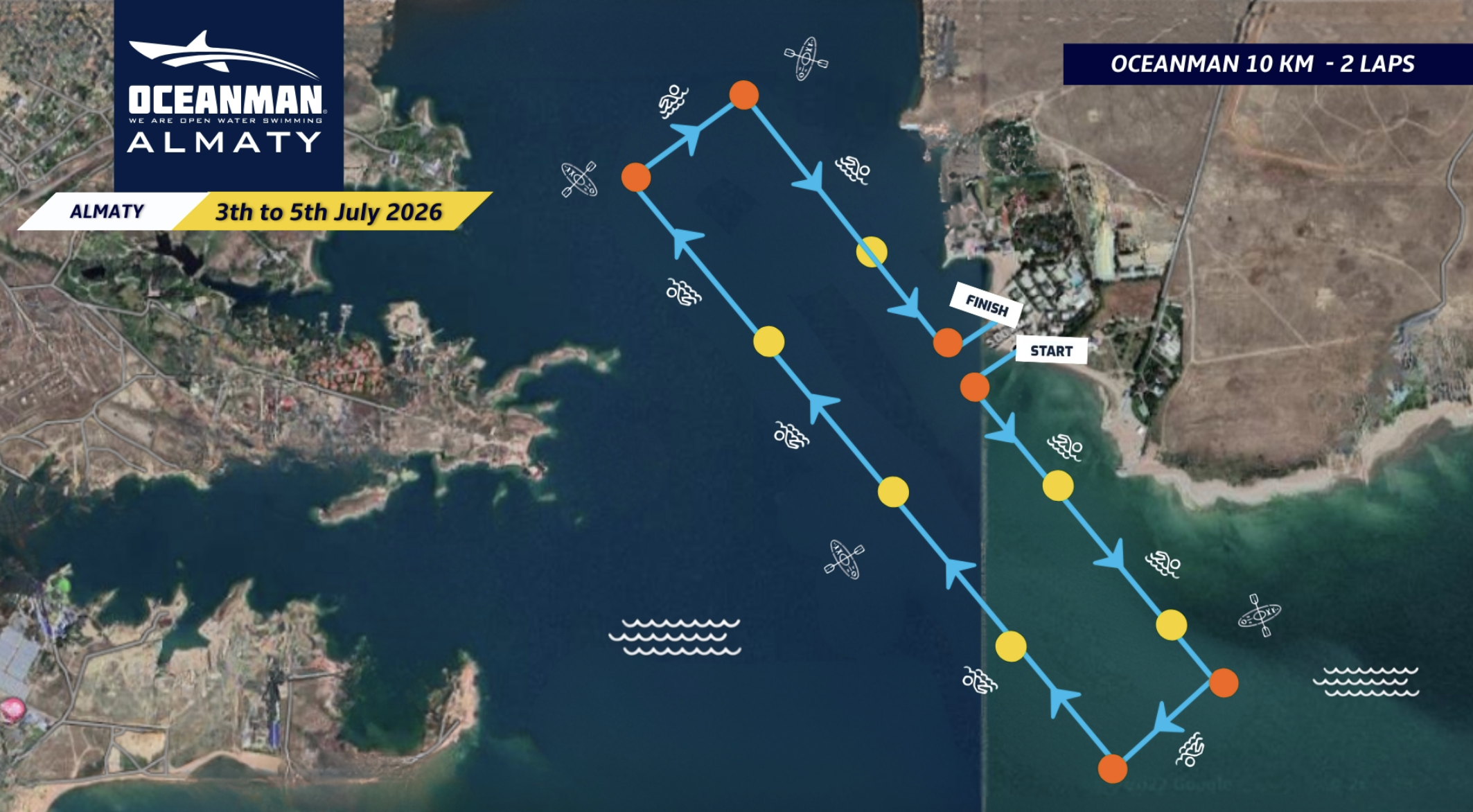
My heart rate must have been through the roof. The initial shock from jumping into cold water was only exacerbated by strong waves. After the first buoy, I realized I could barely see the following ones. The waves blocked the view and I needed to synchronize my crocodile eye peeks with the falling of the wave in front of me otherwise I wouldn’t see a thing and lose the course. The first kilometer was truly the worst. My mind was battling with an idea that it was going to feel this bad the entire race and the thought of withdrawing rang loud in my head. I came to learn that in endurance sports, the mental battle is more challenging than the physicality of it. I remembered organizers saying if lifeguards come to pick up a swimmer, it means the waves are too high and the race is cancelled for safety reasons, and in that case, swimmers must comply and get on the boat. Game over. Well, during the first kilometer, I was almost praying for that to happen. But it didn’t. So I kept swimming.
I don’t remember much between kilometers 1 and 4, I was concentrated on getting to every next buoy on autopilot. I let the body do its thing. Nearing 5k mark and the first full circle, I ripped the tip of the gel taped onto my buoy and fueled on it. The gel remained taped, efficient and zero waste, might I add! Psychologically, I was prepared to struggle after the first lap realizing I need to pass right by the finish line to swim another lap. To my surprise, this was not a problem. I was just happy I was halfway through. The waves had gotten calmer but the current remained. After kilometer 9, the overwhelming struggle came back. This time, a physical one. I could not feel my shoulders, completely stiff and sore. I talked to myself, saying how little was left. I thanked the water. I thanked the sun and noticed a flock of birds flying by as I lifted my head to take a breath. Stroke after stroke, the body kept doing its thing. It didn’t have a choice.
I'm Ocean(wo)man!
I cried when I crossed the finish line. Then, I was shocked. I had only planned to finish before the cutoff time. I knew I had to add another half an hour to my 10k time in the pool, accounting for the current and the navigation in open water. I finished the race in 3 hours and 58 minutes! Third in my age category and eighth overall. Manat, you are an Oceanman!
In retrospect, I am thankful. For my coach and my team. I am thankful for having the ability to test the limits of my body and mind. I am thankful to learn it takes a lot of time and deliberate practice to get good at something but you do get good at it, and it’s a glass half-full type of situation for me.