teaching
Teaching Philosophy
I believe genuine learning occurs not in isolation of one’s mind and constrained by the time designated to any given lecture but in interaction with the other, perspectives, convictions, experiences, voiced by a peer or written down in a text.
To this end, I strive to shape my classroom around the notions of inclusivity and collaboration. I wish to instill mastery orientation in my students, with compassion for oneself and others. To encourage students to be continually challenged yet not feel belittled if a particularly complex idea or linguistic construction is encountered. I hope it invigorates them instead. Building an environment conducive to these ideals is my responsibility as an educator but will most naturally happen with a contribution of each and every student.
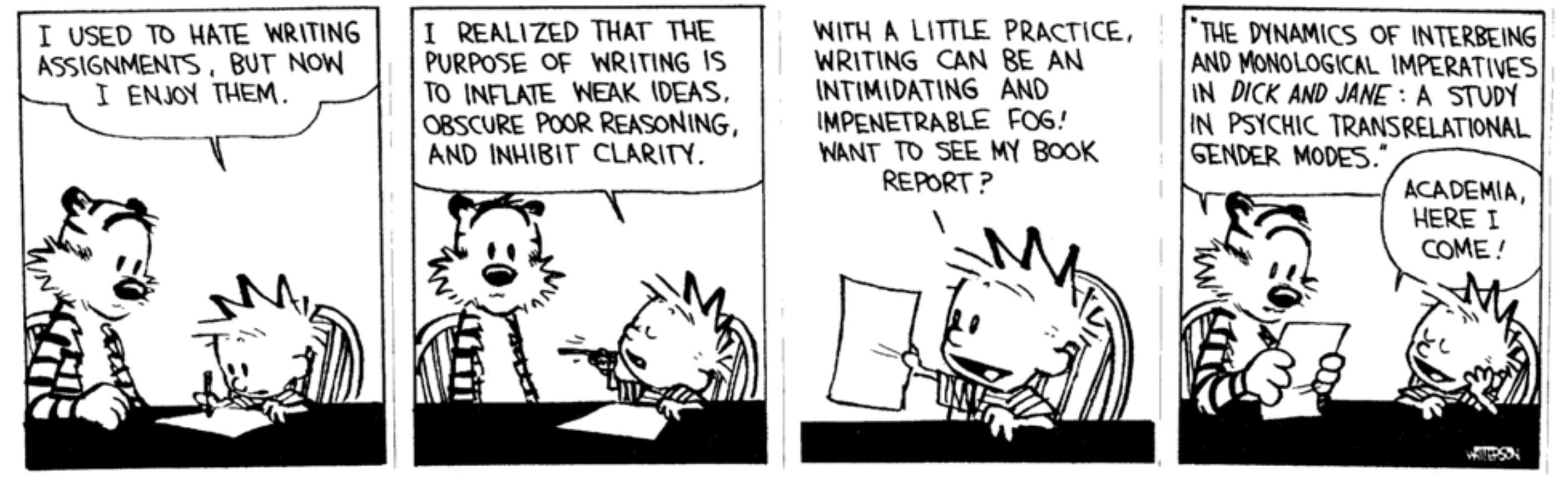
In thinking and writing about my teaching philosophy, I am inspired by a literary scholar Laura Ambrose who was both amused and alarmed by the Calvin and Hobbes comic strip above. She explained,
As an educator, I am troubled by the ways in which students might read our “love” of literature and language as a form of impenetrability and as Calvin suggests, an “inflation” of something that really isn’t there. Many students envision communities of readers as a kind of “Dead Poet’s Society”, exclusive, reclusive, “secret” groups of privileged, gifted individuals. Far from closing gates of access, though, the goal of the college literature classroom is to empower, inspire, and inform growing communities of readers, thinkers, and citizens.
I, too, wish for my students to see language as inviting, empowering, and a perfectly tameable craft if practiced with commitment. I provide useful tools to decipher linguistic elements and ample opportunities to create their own archives of work: essays, literature reviews, journal entries. I alternate small group work, pair discussions, individual writing and reading assignments to cater to varying learning styles. Equally important is for students to come to a realization that they make interventions into the thinking of their peers and mine by offering arguments and lending their thoughts as a valuable member of the classroom and the wider university community.
Recognizing the indispensable role of feedback and self-assessment in honing teaching, I do not take this responsibility lightly. I commit to the challenge of finding creative ways for students to discover knowledge. I aim to actively improve my sensitivity to multiple learning styles, interpersonal mediation of classroom discussions, and thoughtful lecture design. Under my guidance, students should be able to register similarities and differences in viewpoints and revise ideas as a result of careful examination of evidence. My ultimate hope is that they become active members of society equipped with an ability to communicate ideas clearly and effectively.